IGNEOUS ROCKS OF THE SIQUISIQUE REGION, STATE OF LARA ¹
(ROCAS IGNEAS DE LA REGION DE SIQUISIQUE, ESTADO LARA)
by Compañía Shell de Venezuela ¹
Caracas
Fecha: Octubre 1965
Table of Contents
Resumen
Summary
Introduction
Regional Geology
  Stratigraphic Outline
  Tectonics
Petrography
  General Statements
  Serpentinites
  Spilites
  Gabbros
  Ophiolite-limestone compound rocksTuffs to tuffites
  Sediments
Relationship of the magmatic activity witch sedimentation; comparison with similar rock provinces
Bibliography
Illustrations
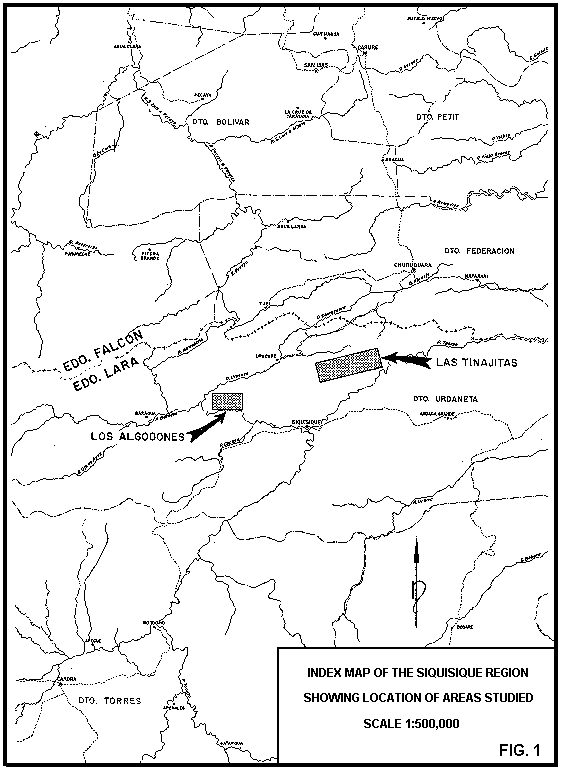
Figure 1 - Index map of the Siquisique region
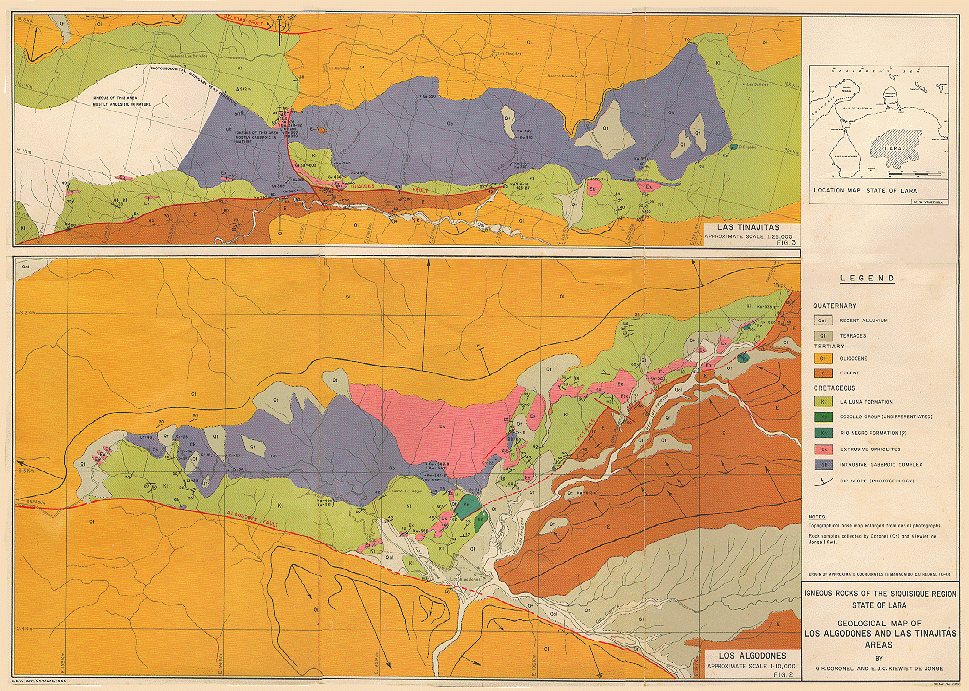
Figure 2 - Geological map of Los Algodones area )
                                                ) on unbound enclosure
Figure 3 - Geological map of Las Tinajitas area )
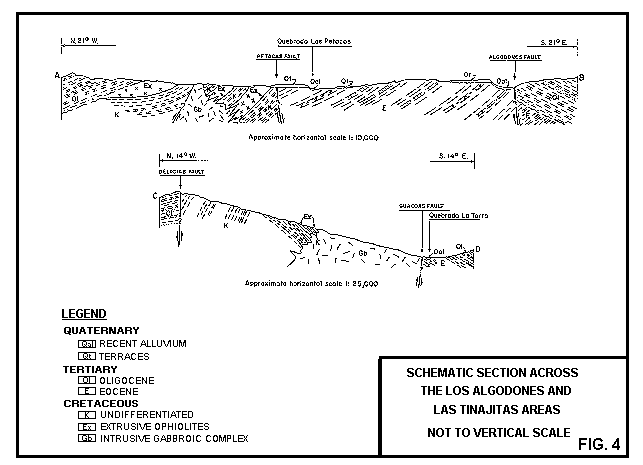
Figure 4 - Schematic section across the Los Algodones
           and Las Tianjitas areas
TABLE I  - Particulars on thin sections of rocks from the Siquisique region
Resumen
Rocas de afloramientos existentes en la región de Siquisique del Estado Lara fueron investigadas petrográficamente por medio de secciones delgadas y fragmentos.
Como complemento a los estudios mineralógicos, en algunos casos se realizaron con éxito análisis de rayos X.
De acuerdo con los resultados obtenidos, las rocas se clasifican en cuatro grupos diferentes, a saber:
Las ofiolitas efusivas a subefusivas fueron (subsecuentemente, quizás) albitizadas (espilitizadas) y en parte carbonatizadas, mientras que los gabros intrusivos sufrieron prenitización.
La asociación de espilita, serpentinita, gabro y ftanita (incluyendo radiolarita) ha sido observada en muchas zonas deformadas orogenéticamente. En los Alpes Suizos, dicha asociación caracteriza a algunas secciones entre las napas orientales inferiores a penínicas superiores, y especificamente a zonas situadas fuera del gran geosinclinal penínico central.
Según las observaciones de campo, al parecer la intrusión del complejo gabroico dentro de los sedimentos tuvo lugar en épocas del Cretáceo Superior, aunque existe la posibilidad de que la actividad volcánica continuó hasta el Paleoceno.
Summary
Thin sections and rock fragments of outcrop samples from the Siquisique region, State of Lara, were petrographically investigated.
In addition to microscopical studies, X-ray analysis was successfully carried out in several cases.
The investigation led to the subdivision of the samples into four groups of rocks, as follows:
The effusive to subeffusive ophiolites were (probably subsequently) albitized (spilitized) and partly carbonatized, whereas the intrusive gabbros underwent prehnitization.
The observed rock association of spilite, serpentinite, gabbro and chert (including radiolarite) has been described from mapy orogenes. In the Swiss Alps, it is described from some parts of the lower east alpine to upper penninic nappes, and specifically from areas which have been situated outside the central penninic main geosyncline.
According to field observations, the intrusion of the gabbroic complex into the sediments apparently took place in Upper Cretaceous time, although it could well be that volcanic activity extended into the Paleocene.
Introduction
This report covers principally the results of a petrographical study of outcrop samples from the Siquisique region (Fig. 1), in the northern part of the State of Lara carried out in 1957 on behalf of Compañía Shell de Venezuela by Mr. J. Schilling and Prof E. Niggli of the University of Bern, Switzerland, to whom appreciative recognition is expressed for allowing the release of the present account. The translation of the text, originally written in German, was carried out by R. Blaser.
The specimens were collected by G.R. Coronel and E. J. C. Kiewiet de Jonge during a geological survey of the Los Algodones and Las Tinajitas areas in the Siquisique region (Figs. 2 and 3) between May and June, 1956. The accompanying schematic section (Fig, 4) show the most important stratigraphic and structural relationships across the region. Particulars on thin sections of rock samples examined are given in Table I.
G. Feo-Codecido slightly modified the accompanying illustrations and edited the manuscript.
Regional Geology
(Extracted from Coronel and Kiewiet de Jonge´s private report)
Stratigraphic outline
The rock exposures in this region range from Lower Cretaceous to Quaternary in age. In addition, allochthonous fragments of gneissic and schistose rocks have been found occasionally along some streams, as well as enclosed by Lower Tertiary shales; these metamorphics presumably make up the pre-Cretaceous basement complex, which is not exposed.
The oldest outcropping unit appears to be a quartz pebble conglomerate, no more than 100 meters thick, which is referred to in this report as belonging tentatively to the Lower Cretaceous Río Negro Formation. Under this assumption, this unit is followed, stratigraphically, by a 20-meter interval of sandy limestones with smaller Foraminifera and Mollusca typical of Cogollo limestones of Aptian-Albian age. These rocks are conformably overlain by a rhythmic sequence as much as 150 meters thick of carbonaceous shale, dense limestone and black chert bands, with abundant Radiolaria unidentifiable smaller Foraminifera and ammonite fragments, all of which strongly resemble the Upper Cretaceous La Luna Formation elsewhere in Western Venezuela.
Basic igneous intrusive rocks, predominantly of gabbroic nature, and associated basaltic to andesitic extrusives are found in the Cretaceous section described above. These rocks appear to belong to a single igneous body, the slight variations in composition being due to magmatic differentiation at the time of emplacement. In addition, the volcanic types are thought to represent extrusive flows of submarine origin. Evidence of contact metamorphism related to the intrusion of the gabbroic body has been observed in some Upper Cretaceous strata (e.g., along the Los Algodones Baragua road, where samples Cr-25 and 26 were taken), but in general the contacts are badly exposed due to weathering and little can be said about their nature; on the other hand, most localities suggest a tectonic contact (e.g., at the locality of sample Cr-16). North of Cerro El Regal, diabase tongues extend into the gabbro mass (sample Kw-588), which clearly indicates a younger age for the diabasic extrusives. The top of the lava flows is generally characterized by a thin cover of tuffites.
No sediments of Paleocene age have been enaountered in situ, but only boulders of fossiliferous Paleocene limestones enclosed by Lower Tertiary shales (e.g., sample Kw-613).
Eocene deposits are moderately exposed throughout the region, where they are seen to occur in fault contact with Cretaceous rocks. These deposits consist mainly of a thick series of shales with sandstone intercalations; the shales are boulder hearing at several localities (samples Kw-523, 524 and 525), the blocks consisting of pre-Cretaceous metamorphic, cretaceous and Paleocene rocks.
Exposures of mottled clays and fossiliferous Limestones of Oligocene age occur extensively throughout the region, unconformably overlying all older rocks.
Tectonics
The Los Algodones area is characterized by two main faults; that is, the northwest-southeast trending Algodones fault, quite evident in the field, and the southwest-northeast trending Petacas fault, which is offset at several places by minor northwest-southeast faults. The Algodones fault separates the Oligocene on the aouth from the Upper Cretaceous on the north, whereas the Petacas fault separates the Eocene on the nauth from the Upper Cretaceous on the north. In both cases, the northern block has been pushed upwards in relation to the southern block.
The predominant feature of the Las Tinajitas area is the southwest-northeast striking Guacoas fault, which separates Eocene deposite on the south from Upper Cretaceous rocks on the north. In this case also, the northern block has been uplifted.
Petrography
(by J. Schilling and E. Niggli, private report date 27/10/57)
General Statements
The inveatigation of the thin sections led to a subdivision of the rocks into four groups, as follows:
One representative rock type from each of these groups will be described below. The sedimentary rocks will be dealt with briefly later.
Serpentinites
Macroscopic description:
The serpentinites are green-black to brown-green, massive and very dense rocks, with rough fracture surface showing no preferred fracture directions. On wet fracture, the heterogeneous structure of the rocks can be recognized. Besides the deeply colored matrix of the serpentinite, light-green irregularly bounded inclusions of cherts of up to 1 cm. in diameter can be observed, and these are alsoirregularly distributed throughout the wole rock.
Microscopic description:
Under the microscope, the rock is tipically reticulare. Sporadically, pyroxenes of up to ½ cm. in diameter can be recognized; their transformation into serpentine has, however, progressed to such a degree that their further determination is impossible.
The serpentinite contains disseminated grains of picotite, which however often appear opaque (even under parallel nicols) because they are covered by an extremely fine film of ore.
Interpretation:
The inclusions of chert indicate that the intrusion of the ultrabasic magma took place after the sedimentation and lithification of these rocks, because the inclusions have very sharp boundaries and consist of quartz only. Allochthonous material, which could be of igneous origin (e.g., chlorite), is missing. Such is not necessarily the case, however, with regard to other inclusions of chert in ophiolites; this is discussed below.
Spilites
Two different varietis of spilites can be distinguished, as follows:
Cabonatized Spilites
Macroscopic description:
These are very fine grined rocks; the grain size averaging ca. 1/10 mm. The color is grey-green. A fine net of veinlets filled with calcite and quartz traverses the rocks in all directions and gives it a very heterogeneous brecciated apparance.
Microscopic description:
Under the microscope, albite, chlorite, titanite, epidote, ore, calcite and quartz are recognizable.
Calcite, chlorite, epidote and ore (supposedly limonite) form an intersertal matrix, in which are present idiomorphic laths of carbonatized albite and roundish porphyroblasts of chlorite.
The chemical composition of the albites was determined on the universal stage according to the method of Reinhard (1931) and also by determination of the maximum extinction. Values of 3% An (=albite) were obtained by the former, and values of 5% An (=albite) were arrived at by the latter method. The albite twinning law is predominant, but larger plagioclases are also twinned on the pericline law.
Sporadically, pseudomorphs of calcite after pyroxene can be observed.
Calcite is seen not only in the intersertal matrix and in the carbonatized plagioclases, but also occurs together with quartz as cement of the individual rock fragments. The carbonatization appears to originate from the filled cracks, since the spilites which are not brecciated show no carbonatization. Due to the small number of samples no final conclusion on this point can be made.
Chlorite-Albite Spilites
Macroscopic description:
Macroscopically, these rocks are of a gray-green color, similar to the carbonatized spilites. They are very dense, homogeneous and fine grained. Rod-shaped plagiolases and roundish grains of epidote can be observed in a black-green matrix. The length of the laths of plagioclase is cat 0.3 mm., whereas the grains of epidote hardly exceed 0.1 mm. in diameter. These chlorite-albite spilites can be distinguished from the carbonatized spilites by the absence of brecciated structure.
Microscopic description:
The mineral constituents are chlorite, albite, epidote, ore, calcite and quartz.
Chlorite, epidote and ore together form a coherent matrix, in which idiomorphic laths of albite and xenoblasts of calcite are distributed. The albite laths are arranged in a more or less radiating pattern.
The plagioclases are twinned on the albite law; however, each lath generally consists of only two or three individual crystals.
Due to the high degree of decomposition, an exact determination of the composition of the plagioclases is not easily obtained. The investigation on the universal stage, with the application of Reinhard's (1931) method, let to an exact value of 3% An (=albite) in one case only. Other less exact determinations indicated contents of anorthite between 3% and 10%.
Chlorite is only found in the intersertal matrix; porphyroblasts such as were observed in the carbonatized spilites are missing.
Calcite is observed in veinlets and also in irregular patches. The dimensions of these patches, however, barely exceed the length of the plagiclase laths. Under strong magnification the subsequent formation of fine needle-shaped crystals, supposed to consist of actinolite, can be recognized at the contact between calcite and chlorite.
Quartz occurs either in veinlets or in inclusions of chert which show diffuse boundaries; because of this, the inclusions of cherts can only in rare cases be recognized macroscopically. These inclusions also contain a certain amount of chlorite. The quartz and the chlorite of the inclusion were determined by X-ray analysis.
Interpretation:
The diffuse boundaries of the inclusions of chert indicate the possibility that the intrusion of the spilites occurred into a silica mud, which at that time was not yet consolidated. The chlorite could have been introduced into the silica mud during the intrusion of the spilites, on the other hand, it could have been present in the sediment before the intrusion of the spilites, as a product of older reworked ophiolites. It cannot be decided which of these two possibilities is more likely to be the case.
Gabbros
These rocks form the bulk of the ophiolites.
Macroscopic description:
With the naked eye, only grey plagioclase and hornblende can be recognized. The grain size of both the light and the dark minerals is up to 1 cm. The individual mineral grains are, however, divided into fragments, the size of which does not exceed 2 mm. The boundaries of the grains are jagged and torn up due to mechanical stress. The dark constituents were arranged in layers by cataclasis. The rocks are traversed by a close net of fine ultramylonites, which gives the superficial impression that the rocks are of much finer grain than is actually the case.
Microscopic description:
The effects of strong mechanical stress are also seen under the microscope (porphyroclasts of plagioclases and hornblende swim in the finer grained matrix of hornblende, chlorite and plagioclase). The clastic to mylonitic structure is, however, often masked by post-tectonical formation of prehnite.
The mineral association is plagioclase, hornblende (partly in form of uralite), chlorite, serpentine, ore, calcite and prehnite.
The plagioclases are twinned on the pericline and albite laws and they have a dirty and cloudy appearance due to incipient prehnitization and carbonatization. The twin-lamellae are often bent and displaced against each other along fracture planes.
The investigation carried out on the universal stage with the method of Reinhard indicated a content of 22% to 28% anorthite for the plagioclase of the strongly prehnitized gabbros; for plagioclases of only slightly prehnitized rocks a content of 30% to 37% anorthite was found. The originally existing content of An may well, however, have been higher, which justifies the term "gabbro" for these rocks.
The hornblende is represented in a slightly greenish and very fibrous variety, which does not show any pleochroism. The individual fibres are torn into small parts-by cataclasis, yet their original connection in the grains is still recognizable. The hornblente may well be derived from primary pyroxene.
The optical characteristics of the hornblende are:
c/ = 22° 2V = ca. 70°
 (Determined-with the Berek compensator) = 0.022
Occasionally, the hornblende is serpentinized or chloritized; pseudomorpha of calcite after hornblende are also present. The carbonatization appears to originate from calcitic patches (or from cracke, which are filled with calcite). Prehnita in stem-like form occurs together with calcite in healed up cracks. Tha prehnite was identified by means of the determination of its optical refraction on uncovered thin sections. For this purpose a set of Cargill liquids was applied.
The optical data are:
 (determined
with thc Berek compensator)
(determined
with thc Berek compensator)
The rock is often completely pretnitized, the prehnitization starting from the cracks which are healed up by this mineral. In this case only isolated relics of fibrous hornblende or of carbonatized plagioclase, occurring embedded in a coarse-grained matrix of radially arranged prehnite, can be observed. An X-ray powder diagram of such a prehnitized rock shows no other lines than those characteristic for prehnite.
Interpretation:
By means of the prehnitization the rock may completely loose its mylonitic structure. The prehnitization can, therefore, be attributed to a metamorphosis closely connected with the crushing of these rocks, since the processes the recrystallization originate at the cracks. Since the cracks may be very young, at any rate younger than the final crystallization of the original gabbros, it is hardly possible that the prehnitization of these rocks is caused by means of autometamorphosis.
The prehnitization is a general phenomenon of the gabbros in the Siquisique region, some 90% of all of the investigated gabbros being partly or totally prehnitized.
Ophiolite-limestone compound rocks
The intrusion of the gabbros into lime-bearing country rocks led to the formation of typical compound rocks. Tectonical origin of part of these compound rocks must, however, not be excluded; analogies with ophicalcites exist.
Macroscopic description:
Macroscopically two different constituents can be recognized in the compound rocks, namely igneous components and limestone. The limestone occurs within the dark-green igneous rock in form of up to 5 mm. thick, slightly undulated, more or less parallel bands. These may coalesce and form a layer of up to 1.5 cm. thickness, which after some centimeters aplits again into various bands.
The igneous rock between these banda forms spindle-shaped lenses up to 3 cm. in length. If the igneous portions have roundish boundaries they are surrounded by halos of limestone, which are somewhat coarset grained aa compare, with the limeatone of the banda and which are at the limit of macroscopical visibility.
In some instances the otherwise smooth igneous/sediment contacts may be fractured by subsequent stress and particles of up to 2 mm. in size produced. The separation of layers of either sedimentary or igneous material may thus be lost and the individual fragments occur in a completely chaotic, indentated intergrowth. The discrimination of such brecciated compound rocks from brecciated ophiolites is then not always possible.
Microscopic description:
Under the microscope, the components of igneous rocks show broken plagioclases, intensively perforated and corroded by calcite, which are embedded in a fine grained matrix of chlorite and serpentine.
Occasionally, however, hypidiomorphically crystalized and comparatively undistorted portione of gabbro, whose dark constituents are completely chloritized, are observed between the bands of limestone.
The plagioclases are twinned on the albite and, sometimes, on the pericline law. Often they are carbonatized, so that the determination on the universal stage gave only inexact values of 25% to 30% anorthite.
Along stringers of the igneous rock or at the margine of subrounded igneous components the calcite forms xenoblastic beads.
Limestones, which contain great quantitiec of chlorite-bearing chert material, may also form compound rocks at the contact with the ophiolites. The precise genetic interpretation of the described compound rocks is not an easy task and cannot be attempted with a few samples. Contact phenomens were not observed in the cherts and radiolarites.
Tuffs of Tuffites
She pyroclastic nature of these rocks could not be proven with certainty. They may also represent sediments with components of igneous rocks.
Two varietes, which are separated by their internal structure, can be distinguished:
Crystal Tuff to Tuffite
Macroscopic description:
Macroscopically, white to reddish grains of feldspar of up to 1 mm. can be recognized, which are baked together by finely distributed limonite of violet appearance.
The rock is interwoven by a network of fine cracks filled by red limonite. The weathored rock, therefore, shows a reddish color.
The "tuffite" is slightly bedded, but the limonite veinlets exaggerate the impression of bedding.
Microscopic description:
Under the microscope also, the rock shows the structure of a crystal tuffite; that is, big fragments of plagioclase and roundish grains of calcite are embedded in a fine-grained matrix consisting of elongated plagioclase laths, the whole being cemented together by a peculiar matrix (glass?).
The fragments of plagioclase are twinned on the albite law. The measurements on the universal stage gave as a result the composition of an acid andesite with 30% to 35% anorthite.
Partly, tho plagioclases aro slightly sericitized or kaolinized. Some individual crystals of plagioclase are often covered by a thin film of limonite.
The grains of calcite, too, are often surrounded by a mantle of limonite, so that they appear almost opaque.
Besides limonite, calcite also takes part in the filling material of the cracks. It is not feasible to decide with certainty if the rock represents a tuff, in the proper sense, or if we are dealing with a tuffite. The particles of calcite point to the latter possibility.
"Lithic Tuffite"
These tuffites are composed of clastic material, which contains fragments of igneous and sedimentary rocks and, additionally, some fragments of crystals.
Macroscopic description:
Macroscopically, roundish to elliptical grains of igneous rocks (up to 9 mm.) and white to light-gray grains of feldepar (up to 1 mm.) can be recognited. Irregularly terminated orange-red grains of dolomite (up to 3 mm.) and occasional greenish chert fragments are equally distributed within the rocks.
The rock, thus, acquires a very heterogeneous green-orange-red sprinkled appearance. Bedding can only vaguely be guessed at.
Microscopic description:
On microscopical inspection, it can be recognized that the fragments of igneous rocks and the sedimentary grains are cemented together by a matrix, which consists of a fine grained substratum of plagioclase laths and which also contains big fragments of corroded plagioclase in the form of skeletal crystals.
The composition of the plagioclase which is contained in the matrix has been determined on the universal stage, as follows:
35% to 38% anorthite = andesine
Partly, the grains o, igneous rocks are of the same composition as the matrix itself (i.e., bigger grains of plagioclase occur in a fine grained matrix); however, grains of carbonatized spilites, which again contains inclusions of chert, also occur.
The sedimentary particles, which take part in the composition of these tuffites, are of a variable composition. In most cases, however, they consist of orange-red grains of dolomite. These dolomite grains are composed of rhombohedra, which mostly appear opaque due to a brown limonitic cover. The identification of the dolomite was, therefore, achieved by means of X-ray analysis.
In addition to the above fragments, chlorite-bearing chert particles and coarse grained quartzites (containing indentated quartz grains and sericite) are also present.
Sediments
It has been mentioned already that the ophiolites occur in association with radiolarites and cherts.
In principle, two types of sedimentary rocks can be distinguished, as follows:
The aspect of the sediments is very diversified; generally the macroscopical discrimination of dark colored radiolarites or radiolaria-bearing cherts from spilites is quite difficult.
Relationship of the magmatic activity with sedimentation: comparison with similar rock provinces
The following remarks are based exclusively on our investigation on thin sections and rock fragments. They shall be given here with all reservation; specific petrographical field investigations would be indispensable in order to arrive at definite conclusions.
Intrusion-or extrusion?
The serpentinites and gabbros quite certainly solidified intrusively (plutonically or subvolcanically). The sharply bounded inclusions of chert and the compound rocks which originated at the contact of igneous with sedimentary material are in favor of this opinion. The spilites, however, probably intruded into not yet consolidated silica mud, so that submarine - effusive to subeffusive solidification can be assumed. The few samples of uncertain tuffs do not allow any further statements; they may very well represent submarine tuffites (i.e., redeposited tuffs).
The association
We are dealing here with the classical association of spilite, gabbro, serpentinite and radiolarites (cherts) included, which has been observed from many-orogenes (see, e.g., the statements made by J.F. Turner and Verhoogen, 1951). This association is of an ophiolitic character. In many provinces of this kind, rocks rich in magnanese are found. It would be of interest to investigate the existing rock samples of sedimentary origin from the Siquisique region in this respect. Spilites of a submarine origin often show pillow structures, which are not always easily recognizable in the field. It would be, of great interest to know if such pillow lavas occur in the Siquisique region*. The small rock chips which are at our disposal do not allow any statement concerning this question.
Steinmann (1927) interpreted this rock association as characteristic for an abyssal environment. According to this author ophiolitic magmas would have intruded into the deep marine troughs via tectonical planes. Since the time of E. Davis (1918), the abyssal formation of the radiolarites is doubted by most geologists and petrologists.
The abundant growth of silica organisms could also be explainet by assuming an inorganic supply of silicic acid, which would be associated with the emplacement of the ophiolites.
The problem was discussed in detail by H. Grunau (1946).
In the Swiss Alps a similar rock association is known from some parts of the lower east alpine and penninic nappes (e.g., from the so-called "Aroser Schuppenzone"). There, this special ophiolitic association is not found in the central main geosyncline, but in marginal troughs. The ophiolites which occur in the main geosyncline have other characteristics; spilites are missing there.
A special genetic problem is given by the high sodium content of the spilites. A copious literature deals with this question. Hydromagmatic solidification, or autometamorphosis, or supply of sodium out of the sea water, or secondary metamorphosis by circulating waters (containing CO2) have been mentioned as possibilities. P. Eskola (1946) was able to show, by means of experiments, that a "spilite reaction" possibly can proceed as follows:
Na2CO3 + CaAl2O8 + 4 SiO2 = CaCO3 + NaAlSi3O8
The formation of our carbonatized spilites could, for example, be reconstructed as follows: The rocks were fractured by tectonical stress; in the cracks sodium-carbonate solutions were circulating, displacing the calcium of the plagioclases and replacing it by sodium. Part of the calcium carbonate, originating as a result of this process, cemented the fissures of the rock, whereas the remaining part of it is still present in the plagioclases in the form of a carbonatic impregnation.
The prehnitization of the gabbros, also, may be explained by assuming a similar post-tectonical hydrothermal alteration.
TABLE I - Particulars on thin sections of rocks from the Siquisique region
(arranged according to their classification into tock groups)
Samples collected by: G. R. Coronel and E. J. C. Kiewiet de Jonge
(Explor. Dept., C.S.V.).
This section study by: J. Schilling and E. Niggli
(Mineralogical-Petrographical Institute, Universit of Bern, Switzerland)
SAMPLE NO.      FIELD TERM            LOCALITY      ROCK TYPE      MINERAL COMPOSITION
Cr-8       Igneous                  Los Algodones)                 Serpentine,
                                    area         ) Serpentiniti    quartz, picotite,
                                                 )                 relics of pyroxene.
Kw-390       "                      Q. La Vaca   )
Kw-378     Igneous contact rock     "   "   "    )
Kw-552     Ign. + sedim.            Los Algodones)
Kw-340     Ign. + chert inclusions  Q. La Mocha  )                 Chlorite, albite,
Kw-371     Igneous                  Q. La Vaca   ) Spilite         calcite, epidote,
Kw-373       "                      "   "   "    )                 titanite, quartz,
                                                 )                 limonite.
Kw-379     Ign. + sedim.            "   "   "    )
Kw-521     Porphyritic bas. ign.    Q. Las       )
                                    Petacas      )
Kw-310     Schist                   Q. Chorrerón )
Kw-309     Igneous                  "      "     )
Kw-345       "                      Camino       )
                                    La Vaca      )
Kw-350       "                      Q. Las       )                 Plagioclase,
                                    Palomas      ) Prehnitized     hornblende, uralite,
                                                 ) gabbro          chlorite, prehnite,
Dw-351       "                      Q. La Cueva  )                 calcite, quartz,
                                                 )                 ore.
Kw-361       "                      "   "   "    )
Kw-368       "                      Q. El Tigrito)
Kw-369       "                      "   "   "    )
Kw-365       "                      "   "   "    )
Kw-437       "                      Q. La Mocha  )
Kw-542     Igneous                  C° El Pegal  )
Kw-545       "                      "   "   "    )
Kw-547       "                      N. of C°     )
                                      El Regal   )
Cr-21        "                      E. of C°     )
                                      El Regal   )
                                                 )                 Plagioclase,
Cr-11        "                      Q. Las       )                 hornblende,
                                    Petacas      ) Prehnitized     uralite, chlorite,
                                                 ) gabbro          prehnite, calcite,
Kw-588       "                      N. of C°     )                 quartz, ore.
                                      El Regal   )
Kw-388     Ign./chert               Q. La Vaca   )
Kw-389      "    "                  "   "   "    )
Kw-556     Hornblende gabbro        Los Algodones)
                                    -Baragua road)
Kw-561        "         "              "      "  )
Kw-313     Lst./ign.                Q. Chorrerón )
Cr-16      Igneous                  N. branch of )
                                    Q. Paganas   )
                                                 )                 Plagioclase,
Kw-318       "                      Q. Chorrerón ) Gabbro          chlorite, hornblende,
                                                 )                 serpentine, calcite,
Kw-427       "                      "      "     )                 ore.
Kw-436       "                      Q. La Mocha  )

Kw-538     Sed. rock with ign.      Los Algodones- "Lithic         Plagioclase, glass,
                                    Urucure        tuffite"        débris of chert,
                                    trail                          dolomites.

Cr-43      Volcanic rock            N. of Los      Crystal         Plagioclase,
                                    Algodones -    tuffite         chlorite, calcite,
                                    Baragua road                   glass.

Kw-312     Contact rock             Q. Chorrerón )
Kw-317     Igneous/shale            "      "     )
Kw-393     Ign./contact rock        Q. La Torta  )                 Plagioclase,
                                                 ) Ophiolite-      chlorite,
                                                 ) limestone       calcite,
Cr-22      Igneous                  N. branch of ) compound rock   partly components
                                    Q. Paganas   )                 of chert.
Cr-36      Diabase on top of        Los Algodones)
           gabbro                   -Baragua road)
Cr-35      Bas. ign. at contact      "        "  )

Kw-618     Diabase on gabbro         "        "    Chert

Kw-601     Lst. + ign. grains       E. of Q.       Conglomerate    Fragments of fossil
                                    La Vaca                        of spilite and of
                                                                   chert. Pellet
                                                                   limestone.

Cr-10      Igneous                  Los Algodones  Radiolarite     Fossils:
                                    area                           Spumellaria and
                                                                   Nassellaria.

Kw-602     Bas. igneous             E. of Q.       Radiolarite     Components of
                                    La Vaca                        dolomite.
                                                                   Fossils:
                                                                   Spumellaria.

Cr-3       Lst./ign.                Los Algodones  Quartzite-lime-
                                    area           stone-dolomite
                                                   breccia

Kw-320     Igneous                  Q. Recoveco    Quartzite       Quartz, calcite,
                                                                   muscovite, zircon,
                                                                   components of chert.

Cr-33      Black shales + thin      S. of          Organic sediment
                                    Los Algodones  with spicules of
                                    -Baragua road  spongia and with
                                                   spumellaria with
                                                   organic pigment.

Cr-23      Igneous                  Los Algodones  Chert breccia
                                     Baragua road
Bibliografía
Davis, E., 1918. The Radiolarian Cherts of the Franciscan Group. University of California Publications. Bulletin of the Department of Geology.
Eskola, P., 1946. Kristalle und Gesteine. Springer Vorlag Wien.
Gerth, H., 1936. Die Bedeutung des Magmas in der Orogenese der südamerikanischen Kordillere. Geologische Rundschau, Vol. 27, Heft 1.
Gerth, H., 1955. Der geologische Bau der südamerikanischen Kordillere. Gebrüder Bornträger, Berlín - Nikolassee.
Grunau, H., 1946. Die Vergesellschaftung von Radiolariten und Ophiolithen in den Schweizer Alpen. Ecl. Geol. Helv. Vol. 39, Nr. 2.
Reinhard, M., 1931. Universaldrehtischmethoden. Wepf & Cie. Verlag, Basel.
Steinmann, G., 1927. Die ophiolithischen Zonen in den mediterranen Kettengebirhen. Compte Rendu 14e Congrés Geologique International 1926. Gráficas Reunidas, Madrid.
Turner, F. J. y J. Verhoogen, 1951. Igneous and Metamorphic Petrology, New York.
Winchell, A., 1951. Elements of Optical Mineralogy, Part II, Fourth Ed. John Wiley & Sons, Inc. New York. Chapman & Hall, Ltd. London.
See also: Südamerikaheft, Geologische Rundschau. Vol. 45, Heft 3, 1957.
* Note: pillow lavas were, in fact, reported during the field survey (private communication from G. Coronel to G. Feo Codecido).
¹ Tomado del Boletín Informativo de la Asociación Venezolana de Geología, Minería y Petróleo, Octubre 1965, 8(10): 286-305.